For a long time, I had an ART ECC 1 as my multi effects pedal. Around 2008 I decided I wanted to start using individual analog pedals. Over the decades (ugh) I have taken sporadic snapshots of the pedalboard before certain gigs or after major renovations and so I present here: the evolution of my pedalboard.
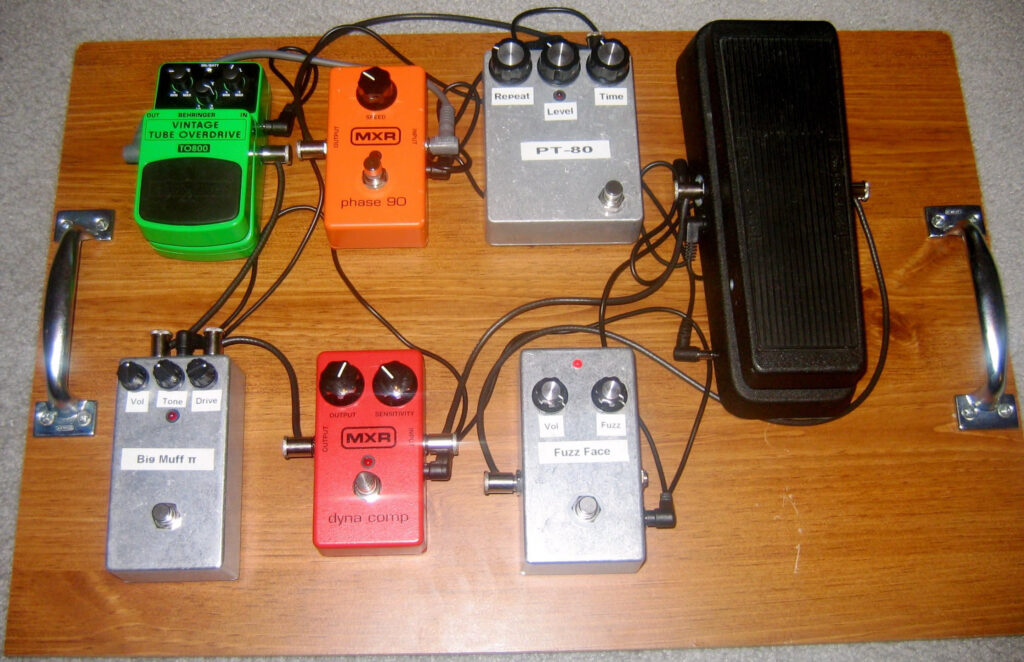
It’s 2008, I discovered General Guitar Gadgets kits (highly recommended) and built a germanium fuzz face, a triangle era Big Muff Pi, and a PT-80 delay. I also picked up an MXR Phase 90 and Dynacomp from the local music store, a Behringer Vintage Tube overdrive, and a sporadically functional wah pedal from Craigslist. What better way to organize these than on a panel from an IKEA desk with Lowe’s cabinet handles screwed on? I gigged with this setup for far too long before purchasing a proper board.
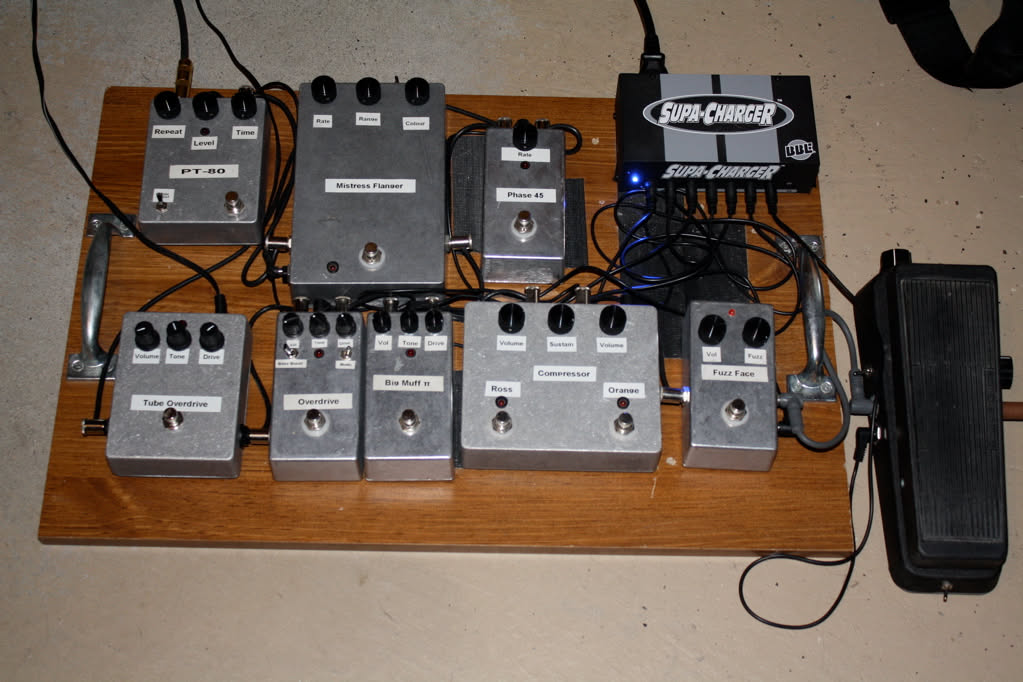
At this point my pedal building problem clearly comes into focus. Let’s take the signal path in order.
The Wah pedal has been gutted and replaced with GGG’s Mod Wah board including a rotary switch for 5 different tone caps (to adjust the Q position) and a three way selector for different inductors. I also have a switch to flip the input and output to achieve the loud “seagul” sound that can be heard on the middle part of Pink Floyd’s Echoes. Next is the the GGG Germanium Fuzz Face, followed by a dual pedal setup consisting of an always on buffer and dual compressors: a Ross and and a Dan Armstrong Orange Squeezer. Next is the GGG Big Muff Pi, a BYOC (Build Your Own Clone, sadly out of business) Tube Screamer (with multiple tone stacks and clipping options). Finishing out my overdrive chain is a Bajaman designed Real Tube Overdrive I built from his schematics and housing a 12AX7 tube.
For modulation I’m uncharacteristically lacking in this era. I swapped out the Phase 90 for a GGG Phase 45 kit, this pedal will nearly always be on my board and is something I consider a bit of a secret weapon for my tone. Rounding it out is a Deluxe Mistress Flanger I build from a GGG PCB (and some scavenged SAD1024 chips that I still hoard jealously) and my PT-80 delay, now featuring a “delay doubler” switch.
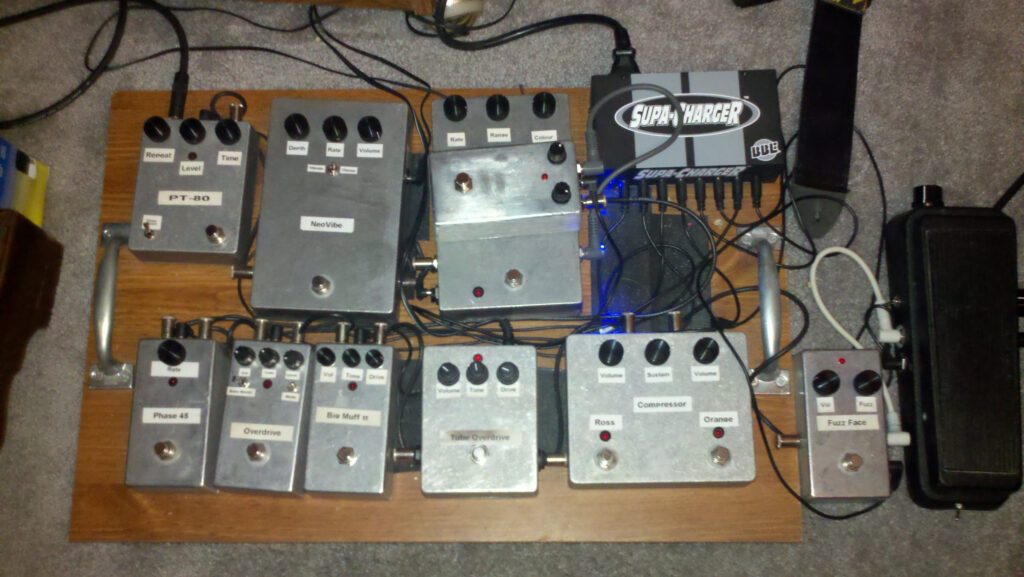
Now clearly entering my “too big for the IKEA wood slab” phase. Everything above, plus the addition of a Neovibe build from R.G. Keen’s specs and an unlabeled pedal that I believe is a BYOC Analog Chorus.
This is the pedalboard used on the Shadows Of Eve album Nowhere But Here.
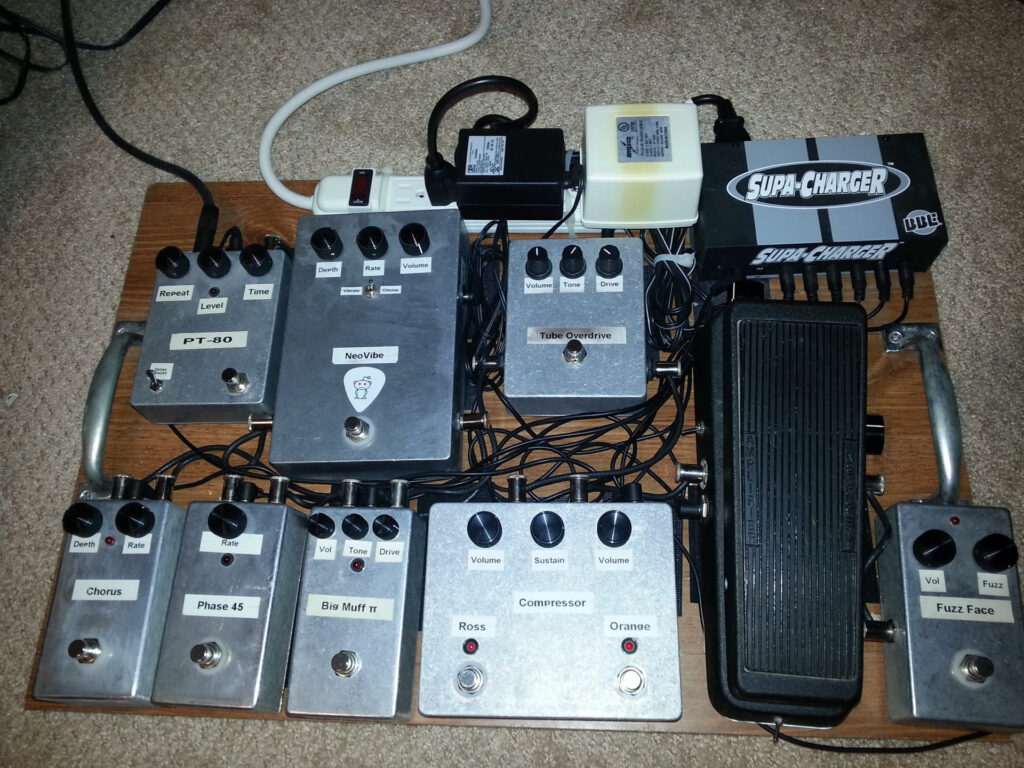
Not much to add here. No new pedals but I did finally get my power distribution a bit under control with a power strip. Notice that the Neovibe needs an 18v DC power adapter and the Bajaman Tube Overdrive requires an inconvenient 16v AC power adapter which will account for it occasionally dropping off my board when space is at a premium.
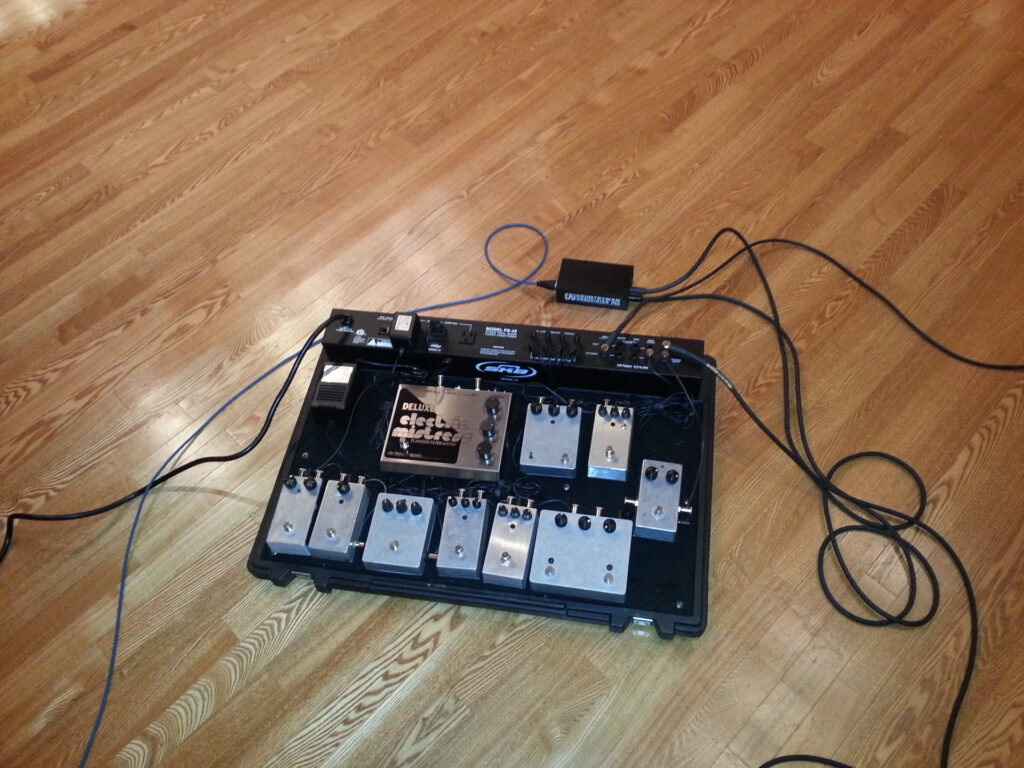
Many changes. Change #1: A proper pedal-board with power and audio jacks. Change #2: labels are convenient, lose them. Change #3: Put an official Deluxe Mistress Flanger on my board to replace the homemade one which was on the bench being re-aligned. Nothing much new here, signal path is GGG Fuzz Face, Bi-Compressor, BYOC Rat clone, BYOC Bug Miff Pi, Bajaman Tube Overdrive, GGG Phase 45, BYOC Analog Chorus, GGG Tremelo, Flanger, Delay. This is the pedalboard used to record Broken World at Audible Images studio (This is a photo from that session)
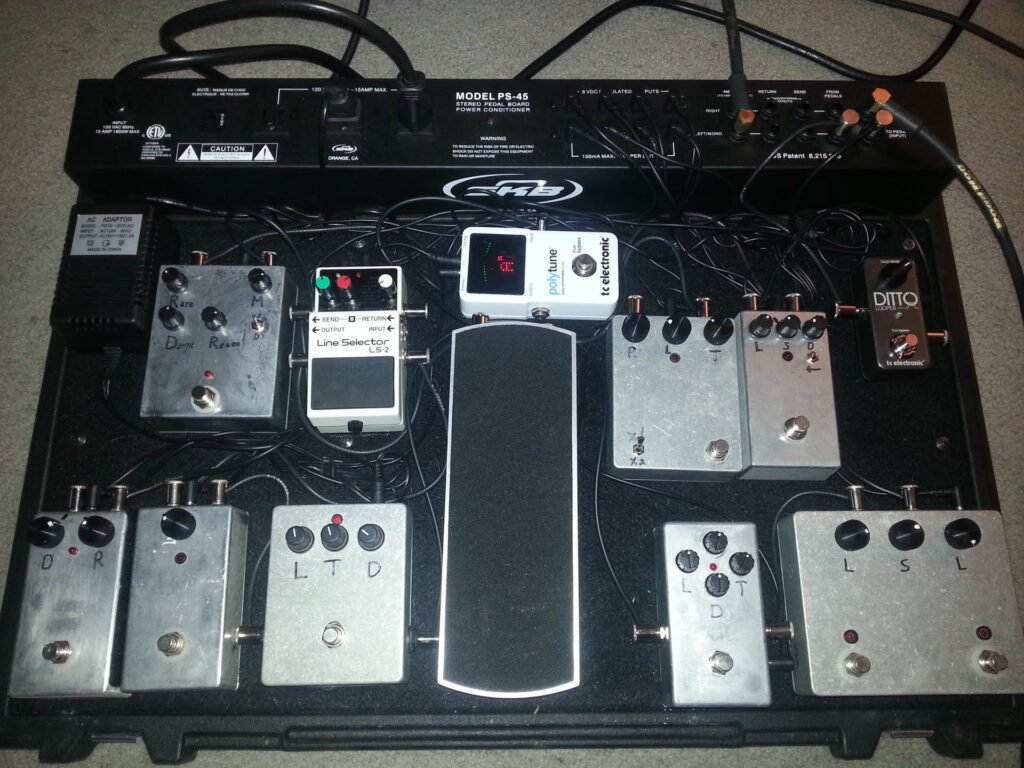
My short lived attempt at being symmetrical. Also clearly my aesthetic of unlabeled pedals was giving way to at least trying to minimally label the knobs. A few new additions here are the excellent BYOC Stereo Flanger (mixed in with a Boss Line Selector) and Ditto looper. Also finally broke down and got a tuner for stage use. Otherwise my usual signal path of compressor, BYOC Big Muff Pi, Bajaman Tube Overdrive, Phase 45, Chorus, Tremolo, Flanger, Delay, Looper.
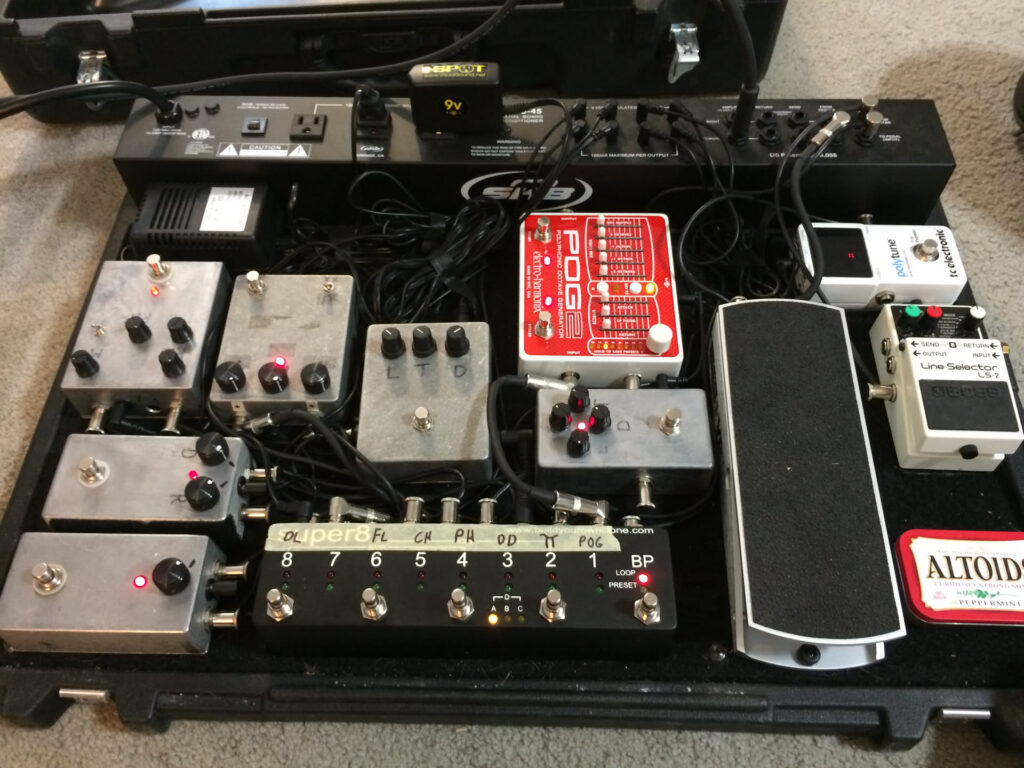
I briefly experimented with an Electro Harmonix POG2, but it definitely was not for me. I also built a BYOC programmable looper to make switching pedal on and off easier (and to program presets of groups of them). Otherwise nothing new here but a surprisingly minimal overdrive selection with only the Bajaman Tube Overdrive and Big Muff Pi.
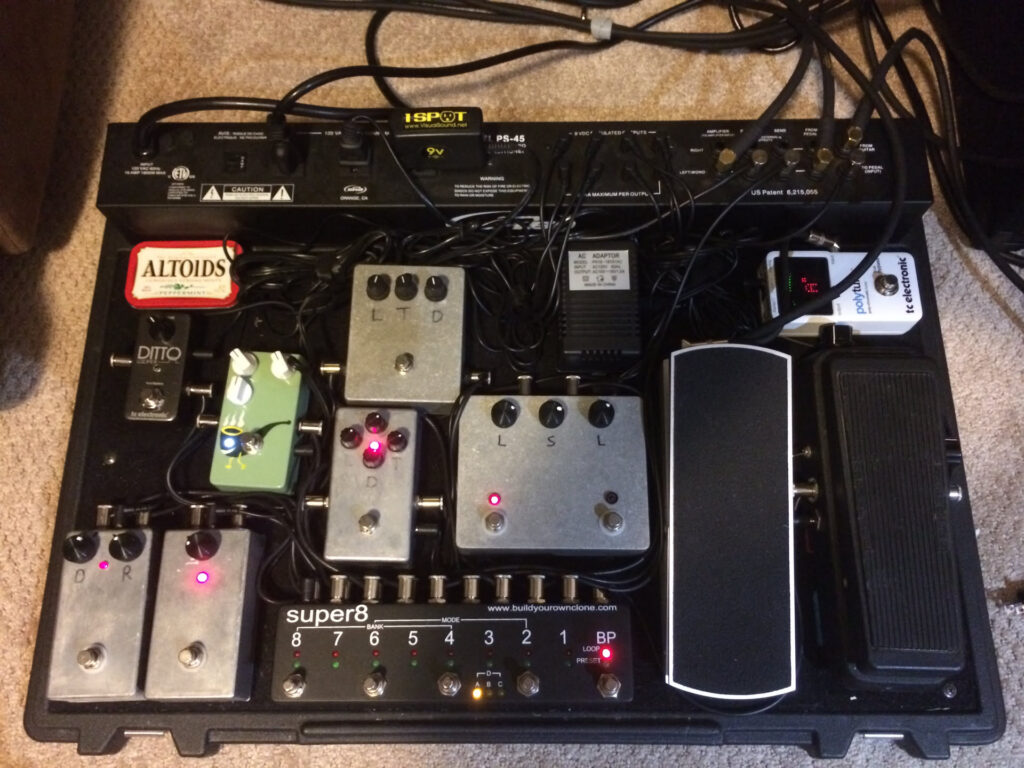
Wah makes a reappearance and will very rarely leave my board from here out. I also have the #0001 serial number Sublime Pep-Pep Delay Pedal with custom graphics adding some rare color.
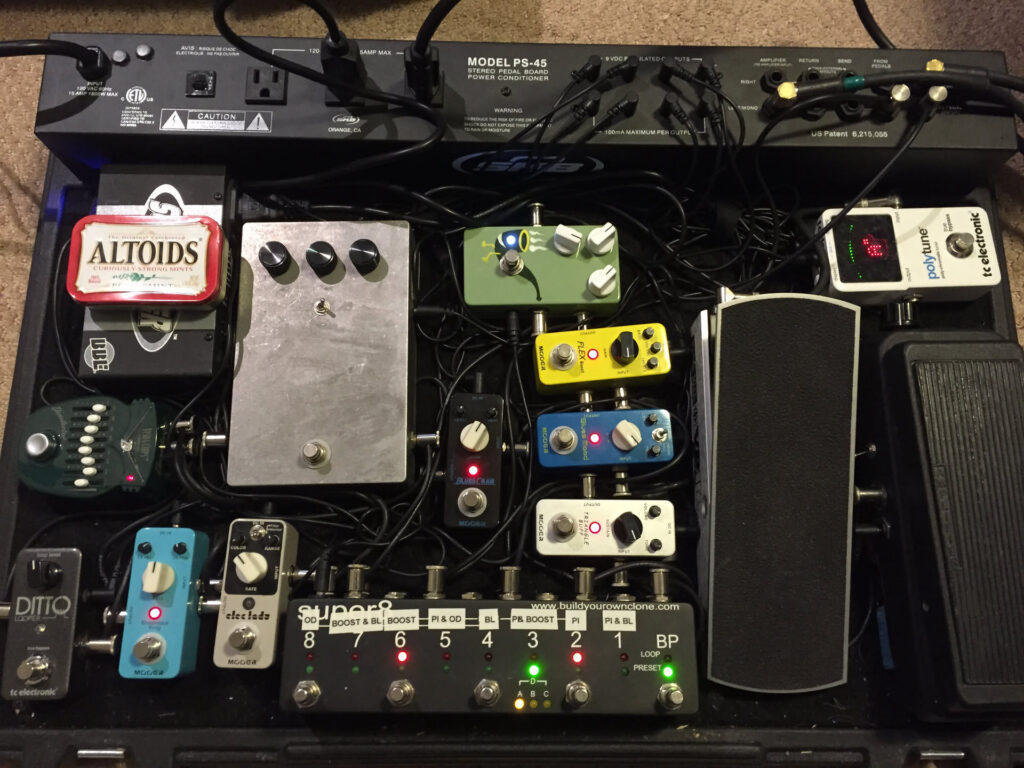
Clearly going for quantity over quality, I went through a period of time where I ditched nearly all of my homemade pedals for inexpensive Mooer clones. Included here are Big Muff Pi, Blues Driver, Boost, Blue’s Crab, Electro Flanger, and Analog Chorus along with my Ditto Looper, Pep Pep delay, a rare appearance by an EQ, and a BIG honking Univibe which I believe is why I switched to so many smaller pedals to try and fit it on the board. Mooer pedals are not the highest quality audio and they didn’t last long but I will say the Flanger is very high quality and matches up against both my Deluxe Mistress Flanger clone and the offical Electro Harmonix version.
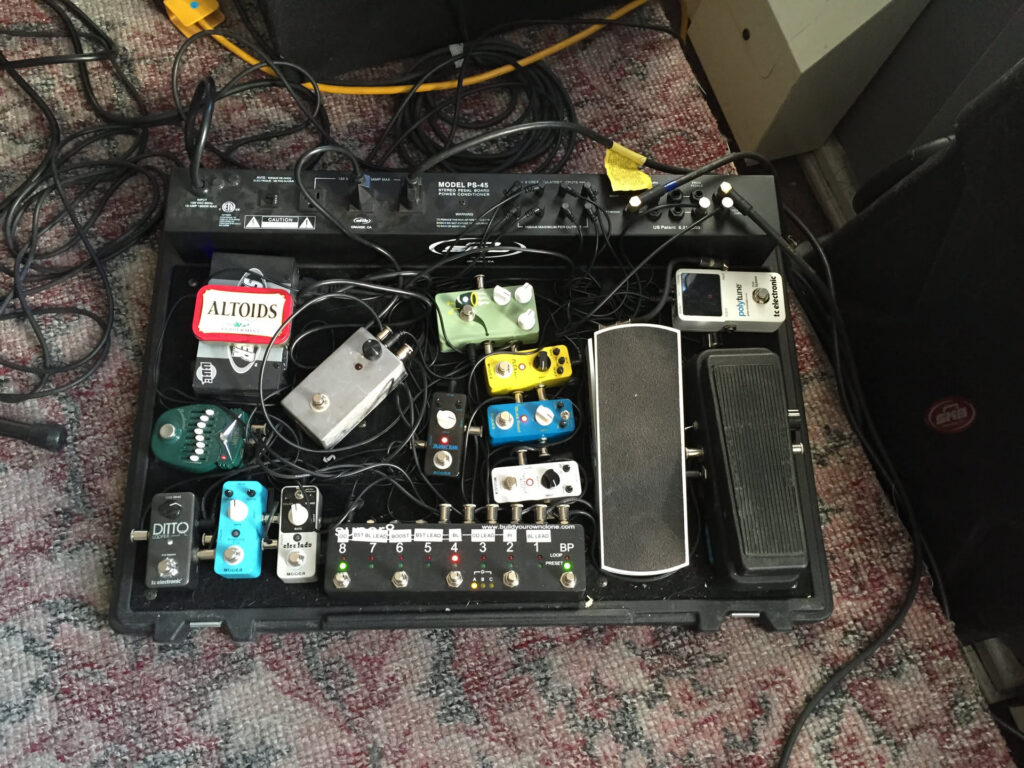
Obviously neatness was not the goal here. This appears to be a random mix of quickly tossed together Mooer pedals with the Phase 45 and Pep Pep delay. The unfamiliar carpet and mess of wires leads me to believe this was taken at a show so it likely was an impromptu setup.
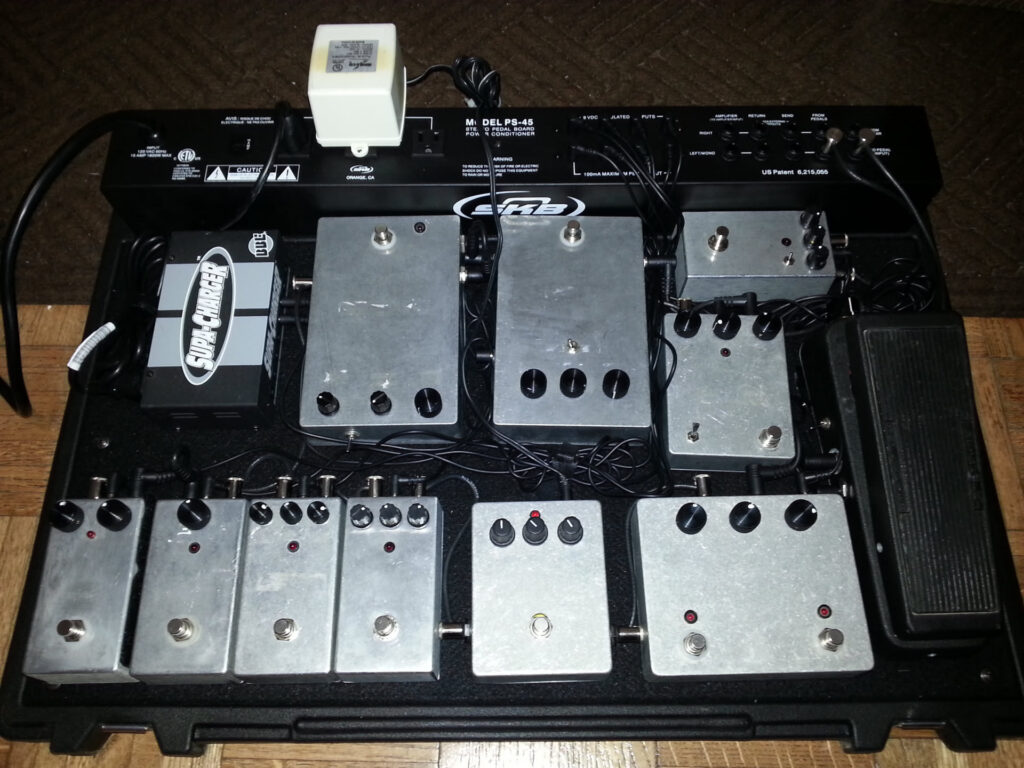
At this point I was going back to my roots of all homemade analog pedals. And again also no labels which makes identifying these kinda tricky many years later. I believe the signal path here is Wah, Bi-Compressor, Bajaman Tube Overdrive, Big Muff Pi, Rat, Phase 45, Chorus, Tremelo, Univibe, Flanger, Delay.
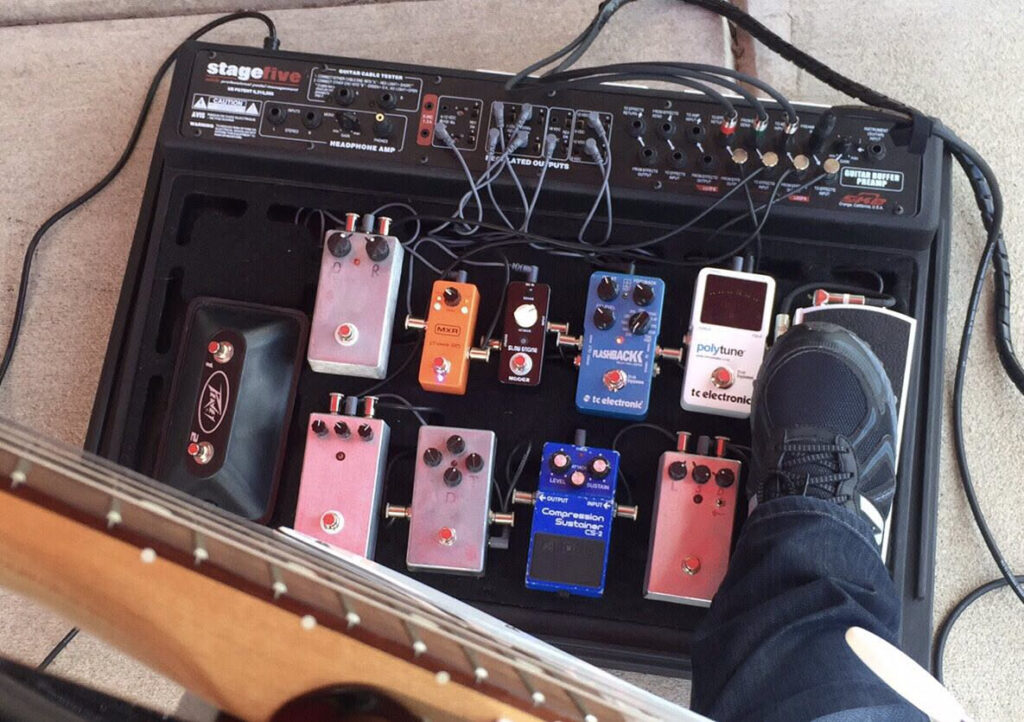
I had this new pedalboard for a while so I am surprised I only have one photo of it that I can find. A mix of previously seen homemade and Mooer pedals (including the Slow Engine to do Vertical Horizon’s Everything You Want) this is noteworthy because it was during a time where I was trying to use my Peavey Classic 30’s overdrive channel (thus the Peavey pedal on the left) and putting my modulation pedals in the amp’s effects loop. I didn’t maintain this setup long due to the fact that it required 4 cables (three in a bundle going back and forth between the pedalboard and amp). This is also marks the first appearance of a classic Boss CS-2 compressor to replace my large bi-compressor pedal and the MXR mini phaser pedal to replace my GGG Phase 45 (this pedal does both 90 and 45 but I only use the 45 setting)
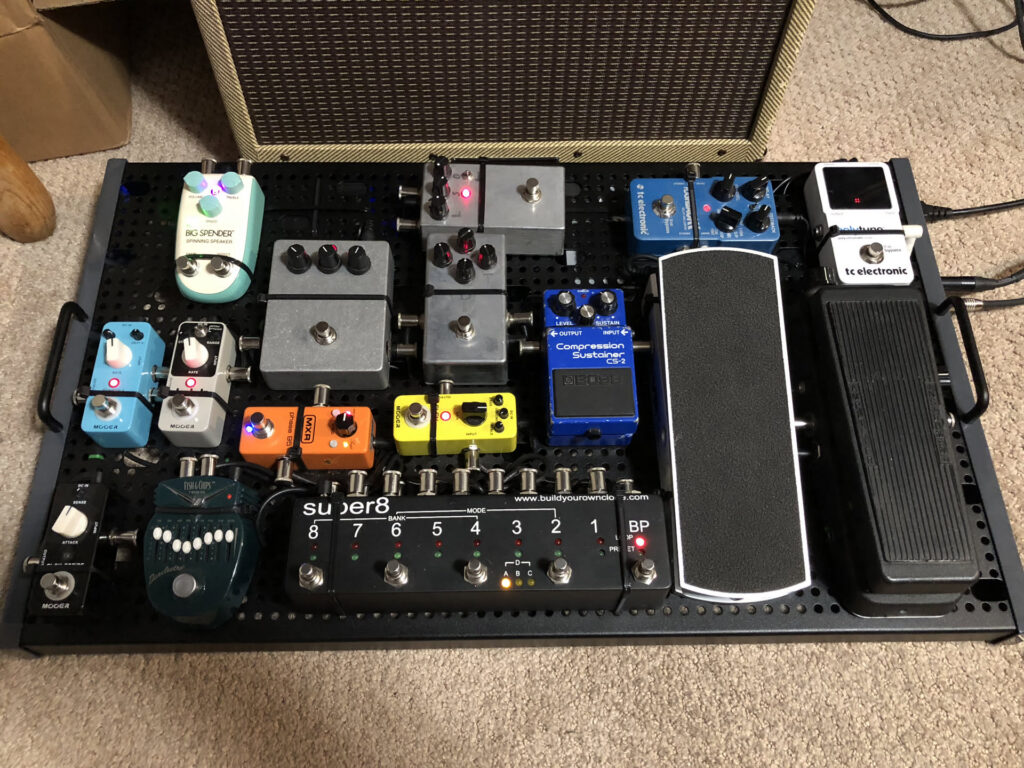
New pedalboard with enough space to store everything I want, with power banks and adapters stored underneath. Wah and looper pedals return, as does the Mooer boost, Slow Engine, Flanger, and Chorus. An new addition is the Danelectro Big Spender spinning speaker simulator my wife got me which stayed in my lineup for a number of gigs.
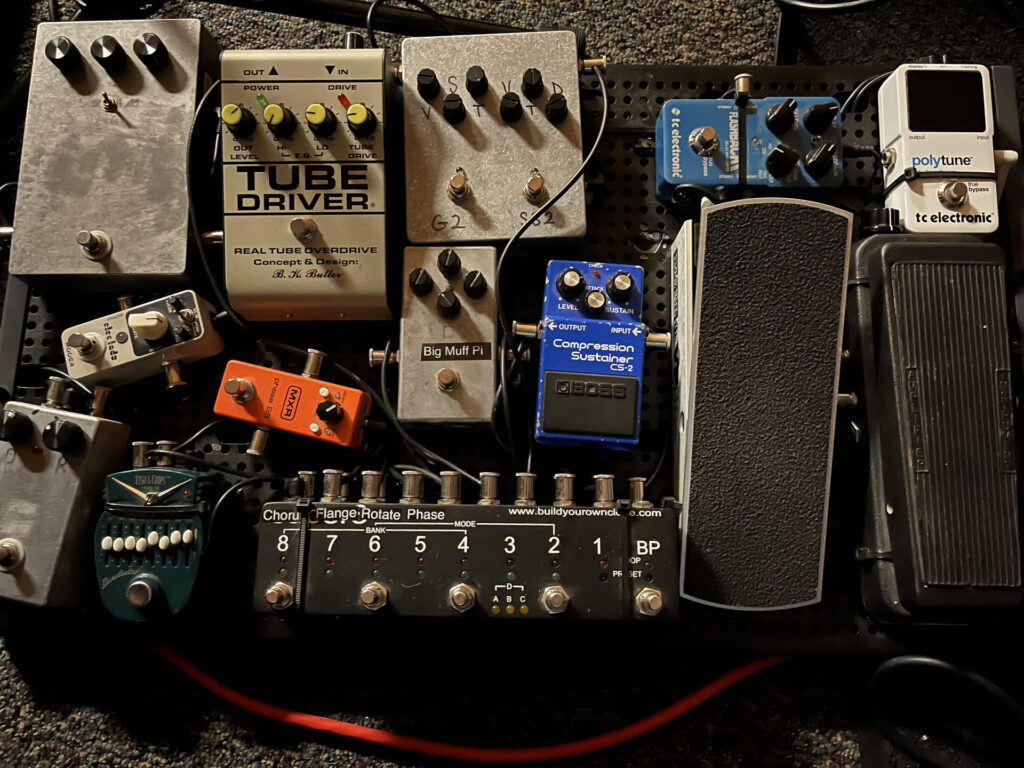
Two notable additions here are a BK Butler Tube Driver to replace the Bajaman Tube Overdrive (not my preference, I actually lost the Bajaman pedal and the bi-compressor at some point but I will be building replacements). Also new to the pedal board is a dual pedal I built to house two Cornish pedal clones, the G2 and SS2.
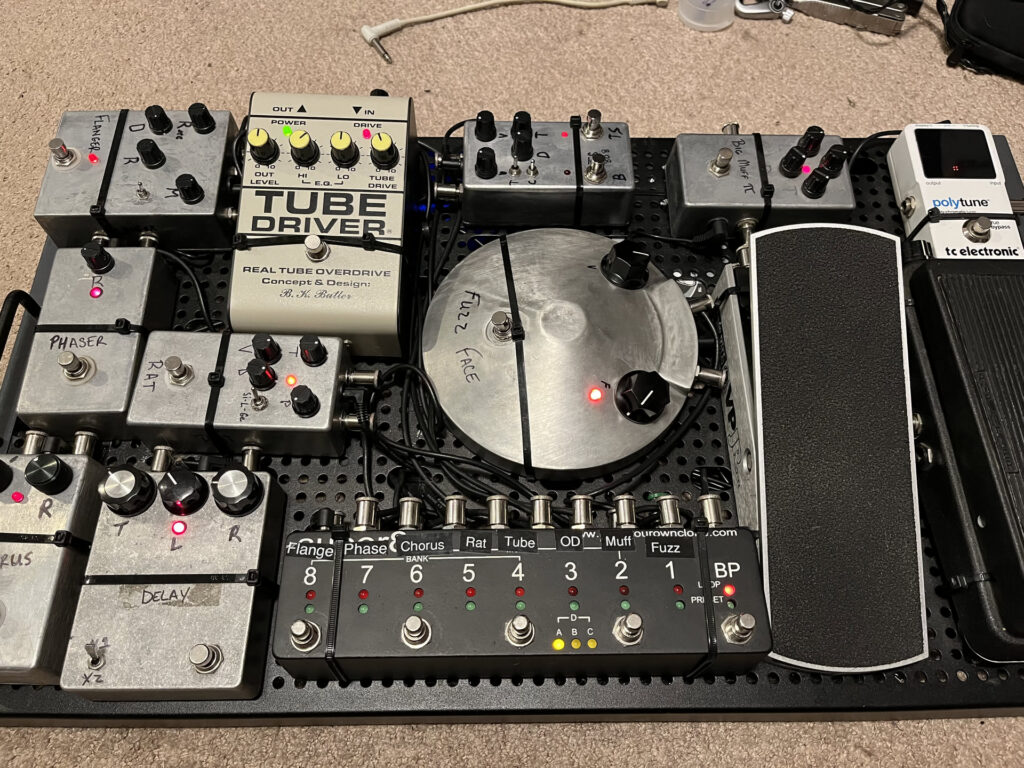
The original GGG fuzz face returns in a custom made (sandblasted) circular enclosure, the GGG PT-80 delay and Phase 45 return along with a BYOC RAT, Chorus, Tubescreamer, Big Muff Pi, and Flanger. This is the pedalboard (and actual settings) used for this show.